


Key takeaways
- When many attendees fly in, travel is often the largest source of a summit’s emissions. That makes the choice of host city and venue one of your strongest levers.
- California’s SB 253 and the EU’s CSRD can bring event-related emissions such as business travel, purchased services and waste into the reporting of large companies.
- Reusable stage systems, plant-forward catering and well-planned signage reduce waste without lowering the guest experience. Digital is not automatically greener than print – usage time, energy and reuse decide.
- Clean event data – attendee travel, hotel nights, catering and production – collected from registration to load-out makes reporting easier for your sustainability team.
- A full-service partner connects these levers: venue sourcing, production, guest management and brand communication in one plan.
Why event sustainability is now a reporting issue
For large enterprises, corporate events are no longer judged only by attendee satisfaction and pipeline. Climate disclosure rules on both sides of the Atlantic now put the footprint of business travel, venues, catering and production under scrutiny.
The overview below reflects the status as of October 21, 2026. These rules are still evolving, so always check the linked official sources for the latest version.
- California (SB 253): The law covers companies formed in the US with total annual revenues above USD 1 billion that do business in California. According to the California Air Resources Board (CARB), the deadline for the first Scope 1 and Scope 2 reports is November 10, 2026. For 2027 and later years, CARB is developing a follow-up regulation. In its July 2026 workshop materials, CARB staff propose that Scope 3 reporting from 2027 should first cover five categories: purchased goods and services, fuel- and energy-related activities, waste generated in operations, business travel and employee commuting. Several of these – above all business travel, purchased services and waste – arise directly from corporate events. This is a proposal; the final rule may differ.
- European Union (CSRD): The Omnibus I directive (Directive (EU) 2026/470) was published in the Official Journal on February 26, 2026 and entered into force on March 18, 2026. It limits sustainability reporting to EU companies with on average more than 1,000 employees and over EUR 450 million in net annual turnover; for non-EU companies, the threshold is EUR 450 million in turnover generated in the EU (European Parliament).
- Germany: The CSRD still has to be transposed into German law. According to the German Chamber of Public Accountants (Wirtschaftsprüferkammer), this transposition has not yet been completed. Companies should therefore follow the progress of the German implementation law.
Smaller German and European companies outside these thresholds can still be affected indirectly, because large customers ask their suppliers for emissions data.
So when a reporting company hosts a 500-person summit in Los Angeles or a leadership conference in Düsseldorf, the event can become part of its emissions inventory. Marketing, procurement and sustainability teams therefore need event partners who plan for low impact from day one – not as a marketing add-on at the end.
Note: This article gives an operational overview, not legal advice. Reporting obligations depend on each company’s size, structure and jurisdiction. Please confirm the details with your legal, tax or sustainability advisors.
Where a summit’s emissions come from
Before you can reduce emissions, you need to know where they arise. How much each source contributes differs from event to event – it depends on where attendees travel from, how long the event lasts, the venue and the format. The overview below shows the typical sources and the most effective measures, without fixed percentages.
| Emission source | What drives it | Concrete reduction measures |
| Attendee and stakeholder travel | Distance, flights with connections, car transfers | Host city with direct flights or rail access; compact agenda that reduces extra nights; hybrid participation for selected sessions; shared shuttles instead of individual cars |
| Hotels and accommodation | Number of nights, building energy, distance to the venue | Hotels within walking distance of the venue; properties with renewable power and sustainability certification; room blocks matched to real demand |
| Venue operations | Heating, cooling, lighting, technical load | Venues with green power contracts; climate and lighting schedules matched to session times; daylight-friendly rooms |
| Food and beverage | Menu choice, over-production, packaging | Seasonal and regional sourcing; plant-forward menus; real-time headcounts; food recovery; reusable serviceware |
| Production, stage and signage | Materials, freight, single-use builds, energy use of screens | Modular, reusable systems; rental instead of purchase; local production; signage that matches how long and how often it is used |
| Freight and logistics | Weight, distance, transport mode | Local suppliers; consolidated deliveries; reusable crates; sea or rail freight where timelines allow |
For most events, you only see the actual distribution once the event data has been collected and calculated.
Venue selection: a key lever
When a large share of attendees travels long distances, the decision about where to meet is often more important than any on-site measure.
- Direct-flight hubs: Cities such as Los Angeles, Frankfurt, Zurich or London reduce connecting flights. For German attendees, Düsseldorf and Cologne are reachable by high-speed rail from Frankfurt.
- Rail and walkability: Venues with walkable campuses or direct rail connections remove the need for shuttle fleets and individual car transfers.
- Certified venues: Ask whether the venue or destination works to ISO 20121, the international standard for sustainable event management, and which share of its power comes from renewables.
For a deeper look at evaluating venues, see our B2B conference venue selection playbook.
Circular stage design: retiring single-use builds
Temporary stage sets are a major source of physical waste at conferences. Foamcore signage, PVC banners, glued carpet and custom plywood often end up in landfill right after load-out.
| Production element | Single-use model | Circular model |
| Stage backdrops | Painted plywood, PVC banners | Modular aluminum frames with recycled tension fabric |
| Floor coverings | Glued carpet, discarded after the event | Reusable modular tiles or bamboo flooring |
| Signage | Printed foamcore boards for a single event | Reusable frames with exchangeable, recyclable prints – or rented screens where content changes often |
| Furniture | Generic rental furniture shipped long distances | Locally rented furniture from sustainable materials |
| After the event | Skip and landfill | Dismantle, crate and store for the next event |
Modular aluminum and tension fabric
Modular aluminum frames clad in dye-sublimated, recycled polyester fabric create high-impact backdrops without on-site sawing or painting. They pack into compact flight cases, which reduces freight volume, and can be reused across several events and markets. Check the venue contract first: some venues have exclusive in-house production suppliers.
Waste-conscious catering without losing the premium feel
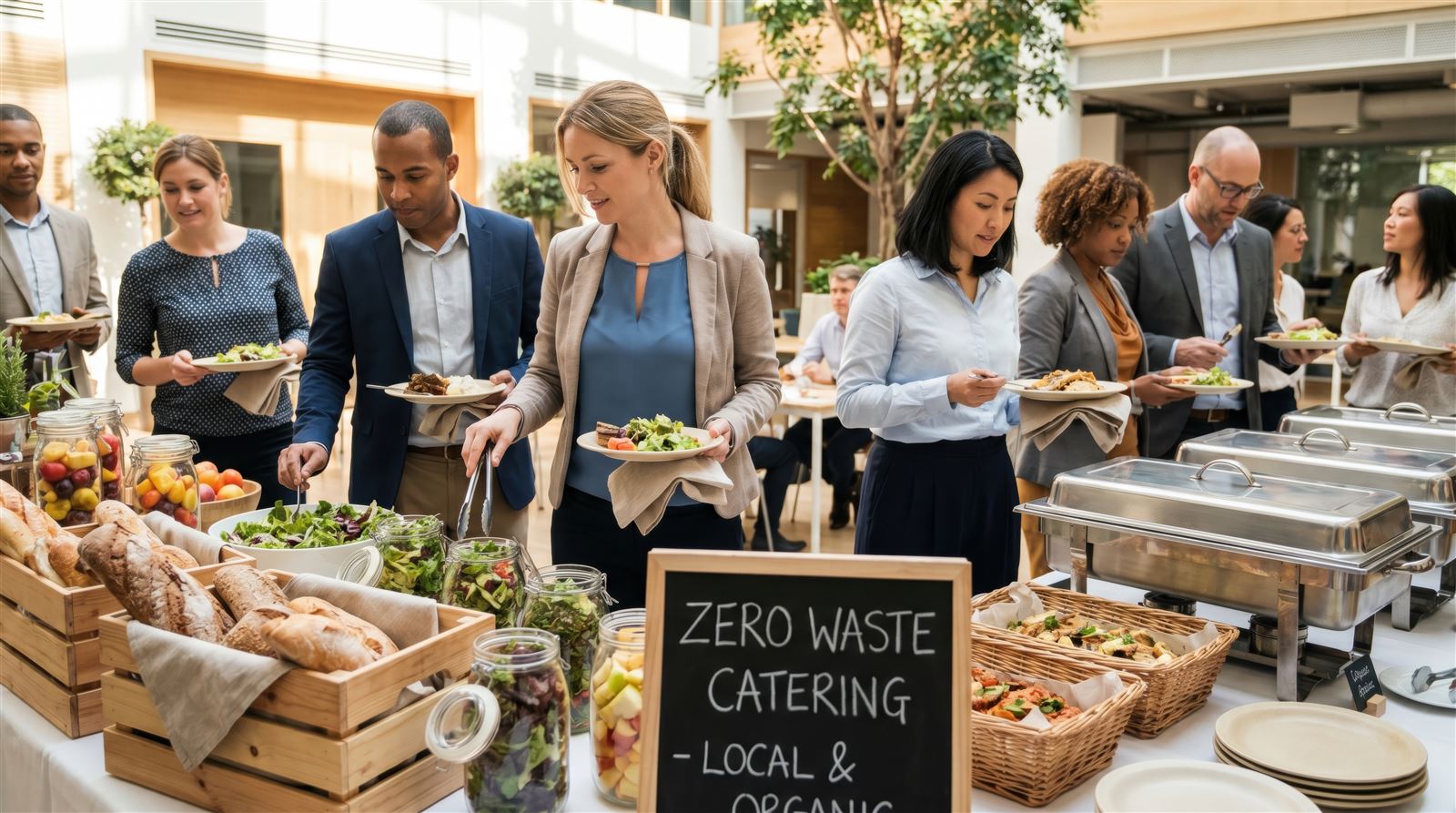
Food is one of the most visible expressions of hospitality at a corporate event. Waste-reduction strategies in catering can raise the experience rather than limit it. Instead of promising “zero waste”, set measurable targets – for example the share of waste that is separated and recycled or composted, or the amount of surplus food donated – and document the results.
- Local, seasonal sourcing: Work with caterers and chefs who source ingredients within roughly 150 miles (about 240 km) of the venue. This supports regional producers and cuts transport emissions.
- Plant-forward menus: Make plant-based dishes the main offer, not the side option. This lowers emissions from livestock and keeps menus light for long working days.
- No single-use plastics: Use glassware, refillable bottles and filtered water stations instead of plastic bottles.
- Food recovery: Track headcounts in real time to reduce over-production, and donate surplus food through food recovery organizations in line with local health rules. In California, SB 1383 requires all venues and events to divert organic materials from disposal, and certain large venues and events must also arrange for edible food recovery (CalRecycle).
Guest communication: less print where it makes sense
- Digital invitations and registration: Save-the-dates, invitations and updates can run through branded digital channels instead of printed mailings. The registration platform can also ask for travel origin, preferred mode of transport and dietary needs – data that later helps with catering planning and emissions reporting.
- Event apps: A branded app with live room updates, speaker bios and networking can replace printed agendas – especially for multi-day events where content changes.
- Badges: Use reusable badge holders and lanyards, and collect them at the exit. Only add NFC or other electronics where they deliver real value, such as contact exchange or access control.
- Data protection: Travel and guest data must be handled in line with GDPR in Europe and CCPA in California.
Digital or print? Choosing signage and OOH responsibly
Digital media are not automatically more sustainable than print. Screens, LED walls and digital out-of-home (DOOH) displays need hardware, transport and electricity. Print can be the better choice for a short, one-off use – if the material is recyclable and the volume is right. Base the decision on three questions:
| Criterion | Questions to ask | Tends to favor |
| Usage time and frequency | How long is the content shown? How often does it change? Is the same signage used at several events? | Digital for frequently changing content and repeated use; print for short, static use |
| Energy | How large and bright are the screens? How many hours do they run? Is the power from renewable sources? | Smaller, dimmable screens with clear run times; green power at the venue |
| Reuse and end of life | Is the hardware rented or bought? Can frames, prints and substrates be reused or recycled? | Rented screens; reusable frames with exchangeable prints; PVC-free, recyclable materials |
The same applies to OOH campaigns around an event:
- Digital OOH: Booking time on existing screens adds no new hardware, but the screens still consume energy. Ask media owners about run times, power source and energy data.
- Print OOH: Paper posters are usually recyclable, while PVC banners are hard to recycle. Choose PVC-free materials and right-size the print run.
- Planning: Fewer, well-placed touchpoints on the attendees’ route – airport, transit, hotel area, venue – often work better than broad coverage.
A sustainability rider for your suppliers
To make sustainability enforceable across a cross-border supplier network, add a sustainability rider to supplier contracts. Typical clauses:
- Local sourcing: A target share (for example 70%) of non-technical goods, floral décor and food from suppliers within about 150 miles (240 km) of the venue.
- Packaging standards: Minimal plastic wrap, no polystyrene, and reusable crates for deliveries.
- Anti-idling rules: No idling engines for trucks and shuttles during load-in at venue docks.
- Data delivery: Suppliers provide fuel, freight and waste data in an agreed format after the event.
ESG-ready event data in three phases
ESG reporting needs data, not estimates. The actual emissions calculation is usually done by the company’s sustainability team or a specialized carbon accounting provider. The event side makes sure the right data exists – and that is far easier to plan in from the start than to reconstruct afterwards.
| Phase | Focus | Output |
| 1. Planning | Compare host cities and venues on travel, rail access and energy | Sustainability criteria built into venue choice and contracts |
| 2. Event | Collect travel, hotel, catering, freight and waste data | Structured data from registration, suppliers and venue |
| 3. Handover | Calculation in line with the GHG Protocol by the client’s team or a specialist | Event data ready for the client’s ESG reporting |
Phase 1: Build sustainability into planning
During the RFP and venue phase, compare host cities by expected attendee origins, flight directness, rail access and the venue’s energy mix. If you need a formal carbon forecast before you sign, it can be created together with your sustainability team or a carbon accounting provider.
Phase 2: Collect data during the event
From registration to load-out, the relevant figures are collected: travel origins and modes from the registration platform, hotel nights from the room block, meal numbers from catering, freight volumes and waste data from suppliers and the venue. The sustainability rider in supplier contracts makes sure this data is actually delivered.
Phase 3: Hand over for reporting
After the event, the collected data is compiled by category and handed over to your sustainability team or the provider of your choice for the emissions calculation. Agree the format, scope and timeline before the event. Formal verification remains the job of the company’s assurance provider.
US vs. Europe: what changes for transatlantic summits
- Europe (Germany, Switzerland, France, UK): A growing number of venues and destinations work with ISO 20121 or national sustainability labels. Waste separation, green power contracts and supplier documentation are often part of the tender. In Germany, the rail network makes low-carbon arrival a realistic option for many domestic and European attendees.
- California: The state has some of the strictest environmental rules in the US, including organic waste diversion for venues and events under SB 1383 and, through SB 253, emissions disclosure for large companies.
An event partner who works in both markets helps you align planning with California requirements and EU reporting expectations – whether you are a European company planning an event in California or a US company hosting a meeting in Germany, Austria or Switzerland. Statutory obligations, offset accounting and local tax treatment always depend on each company’s jurisdiction and disclosure framework. For the operational side of cross-border events, read our guide to cross-border corporate event planning.
How Vision Spotlight supports sustainable events
As a full-service event and marketing agency, we bring the levers described above together in one plan:
- Venue and hotel sourcing: Host cities and venues selected with travel distances, rail access and sustainability criteria in mind – in California and across Europe.
- Contract negotiation: Sustainability riders and data clauses built into venue and supplier contracts.
- Technical production: Stage, AV and lighting concepts with modular, reusable elements.
- Guest management: Digital invitations, branded registration and on-site communication – GDPR- and CCPA-compliant.
- Brand activation and OOH: Reusable brand assets and an OOH media mix – print or digital – chosen by usage time, energy and reuse, not by default.
- Event data for ESG reporting: We collect the event data and coordinate with your sustainability team or a carbon accounting provider of your choice.
Frequently asked questions
What is the biggest source of emissions at a corporate event?
It depends on the event. When many attendees fly in, especially on long-haul routes, travel is often the largest source. That is why the choice of host city and venue is one of the most important decisions. The actual distribution only becomes clear once the event data has been calculated.
Does SB 253 cover the emissions from our corporate events?
SB 253 applies to US companies with total annual revenues above USD 1 billion that do business in California. As of October 2026, CARB staff propose Scope 3 reporting from 2027 for five categories, including business travel, purchased goods and services, and waste (CARB). Event travel and production can therefore become part of your reporting. The final rule is still pending – check the details with your sustainability or legal team.
Is a sustainable event more expensive?
Not necessarily. Reusable stage systems, rented instead of purchased equipment and accurate catering planning often reduce costs over several events. Higher costs can arise for certified venues or premium local sourcing.
Is digital signage more sustainable than print?
Not automatically. Screens need hardware, transport and electricity. Digital tends to make sense when content changes often and the hardware is rented or reused across events. For a short, one-off use, recyclable print can be the better option.
What is ISO 20121?
ISO 20121 is the international standard for sustainable event management. It defines a management system for planning and running events with lower environmental and social impact.
Do you calculate the carbon footprint of our event?
We plan the event so that the relevant data is collected – from attendee travel to catering and waste – and coordinate with your sustainability team or a carbon accounting provider of your choice, who performs the calculation.
Can you plan sustainable events in both Los Angeles and Germany?
Yes. Vision Spotlight Events works from Los Angeles and Düsseldorf. We support European companies with events in California and US companies with conferences, incentives and brand activations in Germany, Austria and Switzerland.
Make your next summit more sustainable – step by step
A sustainable summit is not a compromise. Smart venue selection, reusable stage design, waste-conscious catering and a media mix chosen with care show that commercial ambition and environmental responsibility can go together.
Planning a conference, incentive or executive summit in Los Angeles, Düsseldorf or elsewhere in Europe? We take your event from concept and venue sourcing to production, guest management and on-site delivery. Explore our corporate event services or tell us about your project.
About the author: Luis Kast is the founder of Vision Spotlight Events, a full-service event and marketing agency with offices in Los Angeles and Düsseldorf. He and his team plan and produce corporate meetings, incentives, conferences, executive retreats, brand activations and OOH campaigns for companies in the US and Europe.